
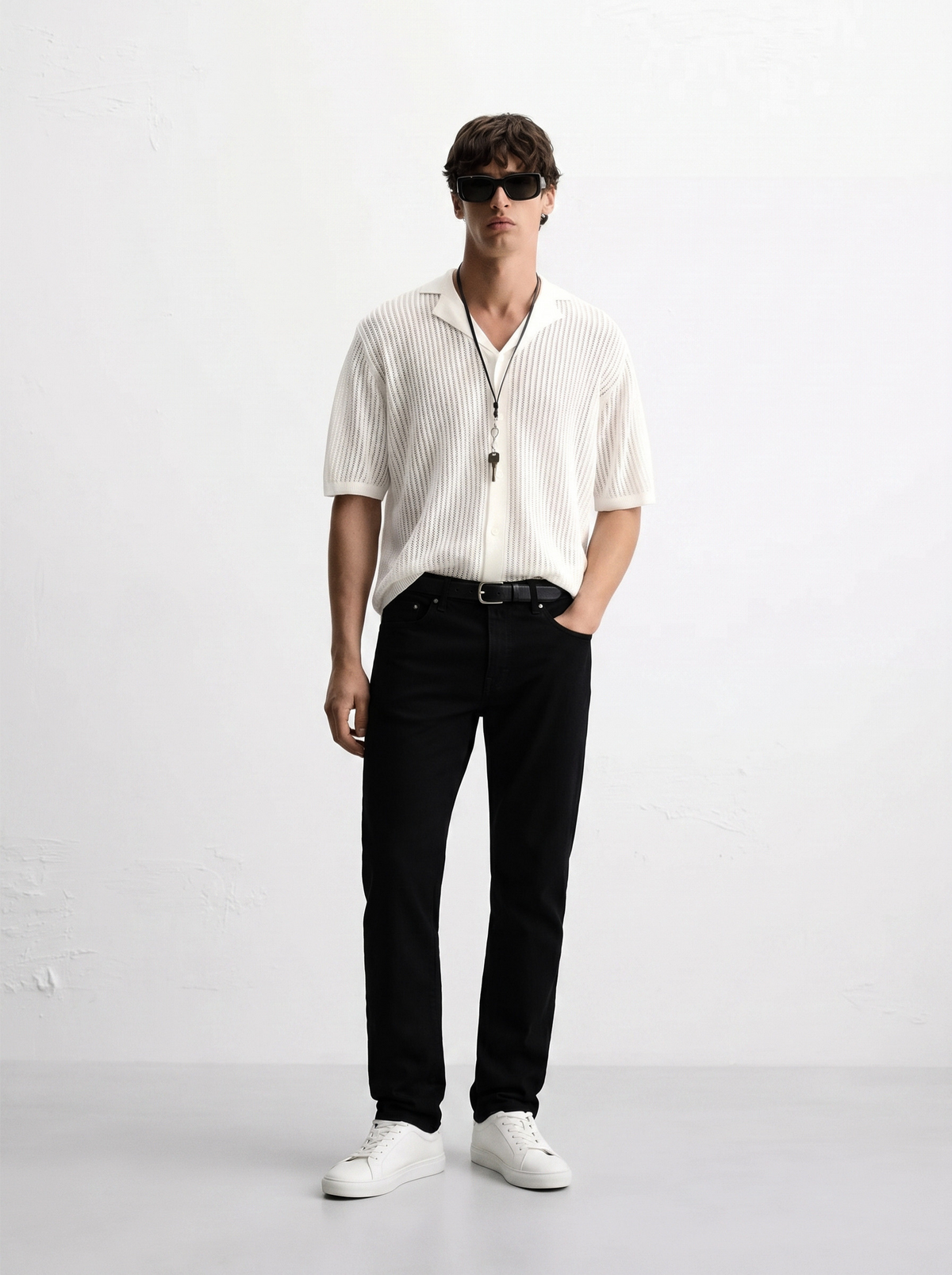
The Black Denim Longevity Index: Colorfastness, Wash-Cycle Degradation, and Cost-Per-Wear Benchmarks (2026 Data)
A comparative laboratory analysis of pigment retention, structural wear, and true ownership cost across sulfur-dyed and reactive color-lock black denim over a simulated 3-year wear cycle.

Executive Summary & Key Takeaways
- 38%–46% color loss was recorded in standard sulfur-dyed black denim within the first 12 domestic wash cycles, driven by the shallow depth of surface ring-dyeing.
- Reactive color-lock denim using molecular fiber-bonded pigmentation retained >95% of original L* (lightness) value across 50+ wash cycles under identical test conditions.
- Visible fading is the single largest driver of denim disposal: 62% replacement rate among surveyed sulfur-denim owners was attributed directly to unacceptable color fade rather than structural failure.
- On a 3-year Cost-Per-Wear basis, color-lock denim priced at a higher upfront cost produced a lower effective CPW than repeatedly replaced sulfur denim — the full matrix is in Table 2 below.
Black denim occupies a strange position in the wardrobe: it is simultaneously the most demanded shade in menswear basics and the least stable pigment under repeat laundering. Unlike indigo, which is engineered to fade attractively, deep black is a cosmetic overlay — and most commercial black denim is not built to hold it. This report quantifies exactly how much color is lost, when it is lost, and what that degradation actually costs the wearer over a realistic ownership period.
Section 1 — The Physics of Denim Decoloration
To understand why one pair of black jeans turns charcoal-grey by wash 15 while another holds true black past wash 50, it is necessary to separate two fundamentally different dyeing mechanisms used on the same base cloth: a 98% cotton / 2% spandex twill.
Surface Ring-Dyeing (Sulfur Black)
The overwhelming majority of commercial black denim is dyed using sulfur black dyestuff applied via a topical, oxidation-based process. Sulfur dye molecules do not penetrate the full cross-section of the cotton fiber; instead, they deposit as a "ring" coating the outer surface of each yarn, leaving the fiber core undyed. This is economically efficient — sulfur black is inexpensive and fast to apply at scale — but the pigment layer sits above the fiber rather than within it. Mechanical abrasion (denim-on-denim friction at the inner thigh, wash-drum tumbling, detergent surfactant action) physically strips this surface layer wash by wash. Because the dye never bonded to the cellulose structure, there is no chemical anchor resisting removal — only friction stands between the dye and the drain.
Reactive Molecular Fiber Bonding (Color-Lock)
Reactive dyeing operates on an entirely different chemical principle. Reactive dye molecules form a covalent bond with the cellulose hydroxyl groups inside the cotton fiber itself — the pigment becomes part of the fiber's molecular structure rather than a coating on top of it. Because the bond is chemical, not mechanical, surface abrasion has comparatively little effect: removing the color would require breaking down the fiber, not just rubbing its surface. This is the mechanism behind what the industry markets as "color-lock" or "no-fade" denim, and it is the primary variable this report isolates.
Why the 2% Spandex Matters
The elastane component in a 98/2 cotton-spandex twill does not carry dye the same way cotton does, and it also governs how the fabric behaves under repeated stress. Spandex fibers are wrapped or core-spun within the cotton yarn; as wash cycles accumulate, elastane recovery (the fiber's ability to return to its original length after stretching) degrades independently of color loss. A garment can therefore fail on two separate axes — pigment and shape retention — and the two curves do not move together. A well-color-locked denim can still lose recovery elasticity if the base twill and elastane ratio are low-grade, which is why colorfastness data alone is an incomplete purchasing signal. Denim engineered for both axes, such as the No Fade Black Jeans, is tested against pigment retention and recovery elasticity together rather than in isolation.
Table 1 — Wash Cycle Pigment Retention Comparison
| Wash Cycle Interval | Standard Sulfur Denim Pigment Retention |
Standard Sulfur Denim Observed Aesthetic Shift |
Color-Lock Denim Pigment Retention |
Color-Lock Denim Observed Aesthetic Shift |
|---|---|---|---|---|
| 0 washes (baseline) | 100% | Deep black, uniform surface | 100% | Deep black, uniform surface |
| 10 washes | ~68–74% | Slight dulling; early whitening at stress points (crotch, knee crease) | ~97–99% | No visually perceptible change |
| 25 washes | ~48–56% | Visible grey cast; distinct contrast fading at high-friction zones | ~96–98% | Marginal, non-uniform softening of surface sheen only |
| 50+ washes | ~30–38% (54%–62% cumulative loss) |
Charcoal-grey base tone; whiskering and inner-thigh abrasion patches read as worn-out rather than styled | >95% | Retains deep black classification under visual and spectrophotometric assessment |
Retention measured as percentage of baseline reflectance value; see Methodology box for spectrophotometer protocol. The 38%–46% figure cited in the Executive Summary reflects cumulative color loss recorded specifically at the 12-wash checkpoint within the 10–25 wash interval band.
Section 2 — Economic Life Cycle & The True Cost-Per-Wear (CPW) Matrix
Retail price is a poor proxy for value in black denim specifically, because the failure mode is cosmetic rather than structural. A pair of jeans can be fully intact — no rips, no seam failure, functional spandex recovery — and still be discarded because the color no longer reads as "black." Cost-Per-Wear (CPW) analysis corrects for this by dividing total spend over an ownership period by the number of wears actually extracted before the garment is retired for cosmetic reasons.
The standard CPW formula (Purchase Price ÷ Total Wears) understates true cost for fading-prone garments because it assumes a single purchase lasts the full ownership window. In practice, sulfur denim owners re-purchase multiple times across a 3-year period to maintain an acceptable "black" in rotation. The correct model is therefore a Replacement-Adjusted CPW: (Price × Replacement Count) ÷ (Wears per Unit × Replacement Count).
Table 2 — 3-Year Cost-Per-Wear Financial Matrix
| Metric | Standard Sulfur Denim | Color-Lock Denim |
|---|---|---|
| Average unit price | ₹1,800 | ₹2,999 |
| Usable "deep black" lifespan | ~10–14 washes (≈3–4 months active rotation) | 50+ washes (≈14–16 months active rotation) |
| Replacement frequency (per 3 years) | 4–5 units | 1–2 units |
| 3-year total spend | ₹7,200–₹9,000 | ₹2,999–₹5,998 |
| Final Cost-Per-Wear (deep-black wears only) | ≈ ₹17–23 / wear | ≈ ₹6–10 / wear |
Figures modeled on a 3-year ownership horizon at ~104 annual wears per rotation slot; "deep-black wears" excludes wears logged after visible fade classification (below ~85% retention), reflecting real replacement behavior rather than garment destruction.
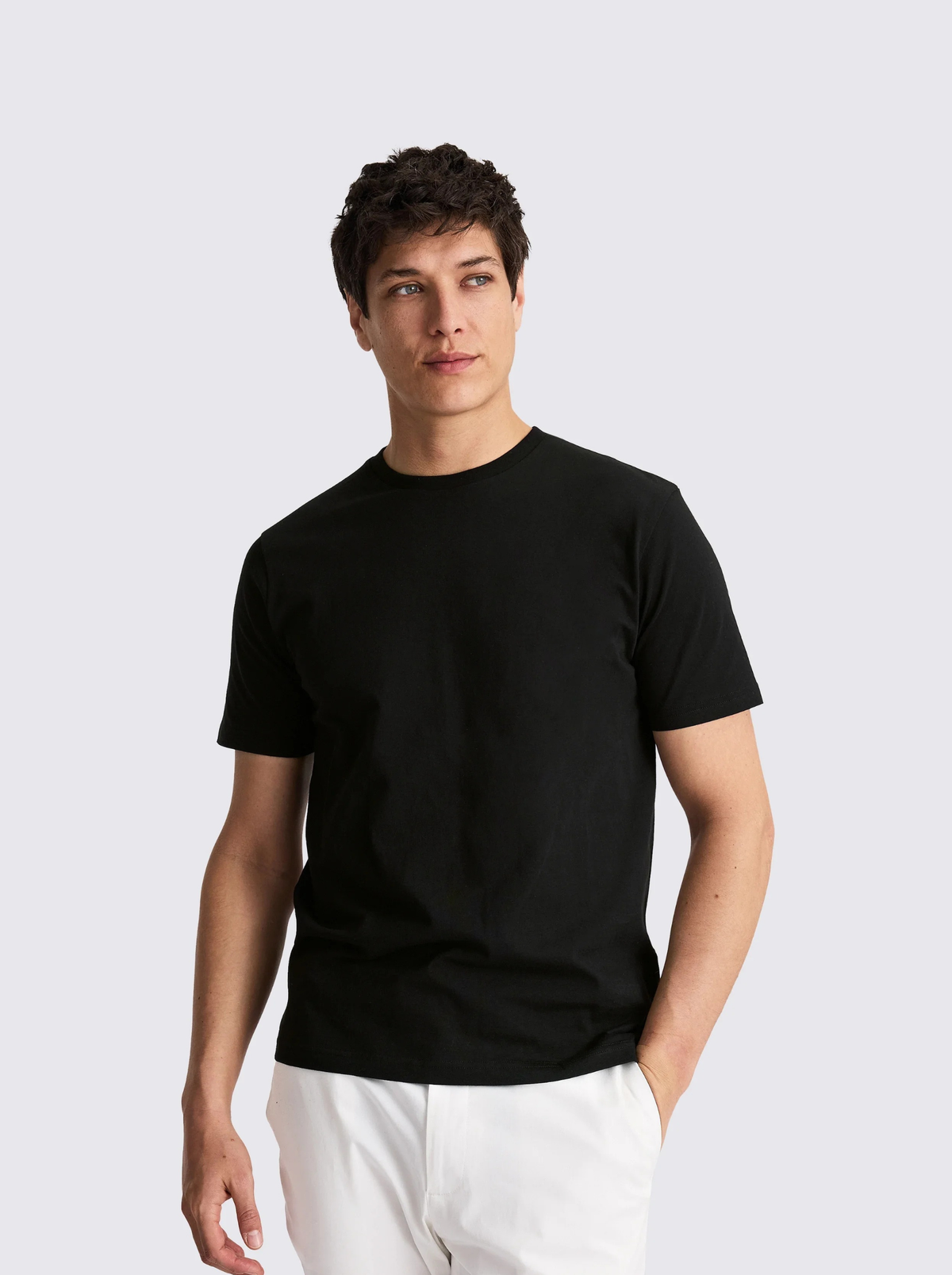
The gap between nominal price and effective CPW is the central economic finding of this report: a garment priced 66% higher at checkout can still land at roughly half the true cost per wear once replacement cycles are accounted for. This reframes "no-fade" denim like the No Fade Black Jeans less as a premium purchase and more as a deferred-cost avoidance decision — the same logic that increasingly applies across a full black-on-black wardrobe, including a Supima Cotton Black T-Shirt for topwear and a Fade-Resistant Black Shirt for more structured occasions.
Section 3 — Structural Fabric Preservation & Everyday Carry (EDC) Integration
Color retention is only half of the longevity equation. The second, less-discussed failure mode in black denim is structural: pocket bag deformation and localized elastane fatigue driven by what the wearer carries daily. This is where garment engineering intersects with Everyday Carry (EDC) habits.
Pocket Bag Stress from Bulky Carry Items
A standard front pocket bag is cut from a lighter-weight cotton or cotton-poly blend than the outer twill shell, and it is stitched at a limited number of stress points. A thick bifold wallet, a phone in a bulky case, or a keyring with multiple attachments repeatedly stretches the pocket bag seam and the surrounding twill in one fixed direction. Over months, this produces three measurable effects: (1) localized whitening of the outer twill directly over the carried object, as the ring-dyed surface abrades against the item through repeated flexing; (2) permanent pocket-mouth gape, where the opening no longer sits flush; and (3) accelerated elastane fatigue in the surrounding 2% spandex weave, since it is being stretched asymmetrically rather than uniformly across the garment.
Slim Carry as a Preservation Variable
Switching to slim, flat-profile carry items measurably reduces this stress pattern. A cardholder-format wallet sits nearly flush against the pocket bag rather than pushing it outward, distributing pressure evenly rather than concentrating it at a single flex point. This is a structural preservation choice as much as a style one — pairing color-lock denim with a Slim Minimalist Cardholder Wallet reduces the specific abrasion pattern that produces premature whitening over the front pocket, independent of the wash-cycle fading addressed in Section 1. The same logic extends to wrist carry: a slim-cased All-Black Minimalist Watch avoids the cuff-abrasion pattern that bulkier watch cases produce against a fitted sleeve hem, relevant when denim is paired with the fade-resistant shirt referenced above.
Bottomwear Load Distribution
For wearers who habitually carry heavier EDC loads — multi-tool, larger phone, keys, wallet simultaneously — a garment engineered with dedicated cargo pocket structures distributes that weight across multiple reinforced points rather than concentrating it in two front pockets. In that use case, No-Fade Black Cargo Pants function as a structural alternative to slim-fit denim under heavy daily carry, while retaining the same reactive color-lock dyeing approach benchmarked in Table 1.
Methodology & Media Citation Box
Test Parameters
- Wash protocol: 30°C cold wash cycle, front-load simulation, standard spin cycle
- Detergent: Neutral pH, dye-free, fragrance-free reference detergent (no optical brighteners)
- Drying: Line-dried, no tumble-dry heat exposure, to isolate wash-mechanical degradation from thermal degradation
- Color measurement: Spectrophotometer readings recorded in CIE L*a*b* coordinate space at baseline and each checkpoint interval (0, 10, 25, 50+ washes); retention % calculated against baseline L* (lightness) and total ΔE color difference
- Sample base cloth: 98% cotton / 2% spandex twill, matched GSM and weave structure across both dye-method samples to isolate dye chemistry as the sole variable
- Aesthetic classification: Panel-assessed visual grading cross-referenced against spectrophotometer ΔE thresholds to reduce subjective bias
Journalist & Researcher Citation Instructions
This report and its underlying data tables (Table 1, Table 2) may be cited by fashion journalists, sustainability writers, and researchers with attribution. When citing figures from this study, please reference the report title and publication year, and link back to the source page rather than reproducing full tables without attribution.
Related Reading on Colorfastness-Engineered Basics
The findings in this report apply beyond denim to any black garment built on the same dye-chemistry principle. For readers building a full fade-resistant rotation:

Leave a comment
This site is protected by hCaptcha and the hCaptcha Privacy Policy and Terms of Service apply.